

Nov 27, 2025
-
By Clive
 AI Summary By Kroolo
Finding the right information exactly when you need it shouldn’t feel like a scavenger hunt. Yet most people still jump from file to file, tab to tab, only to end up empty-handed and frustrated.
And it’s not just you.
According to a recent Gartner survey, 47% of digital workers struggle to access the information they need to perform their jobs effectively — a statistic that perfectly captures today’s workplace chaos.
In a world drowning in tools, docs, chats, and scattered knowledge, having a system that retrieves the right information in seconds isn’t a luxury — it’s mission-critical.
That’s exactly what Enterprise Search delivers: fast, accurate, unified discovery across every corner of your workspace. Let's understand the term more precisely.

Enterprise search is a technology that enables employees to efficiently locate information across diverse internal data sources through a single, unified interface. It represents a fundamental shift in how organizations approach information discovery and knowledge management.
At its core, enterprise search facilitates the indexing, searching, and displaying of pertinent content for authorized users. It manages both structured data (databases and spreadsheets) and unstructured data (documents, emails, and multimedia files). Whether critical information lives in your project management platform, CRM system, email archives, or collaborative workspaces, enterprise search creates a single point of access.
What distinguishes enterprise search from traditional file browsing is its ability to understand context, respect user permissions, and recognize business relationships. Modern systems can process complex queries, offering dynamic responses by aggregating information from various repositories instantly.
According to a 2023 study by Hyland, there was a 21-point increase from 2019 in respondents who say their workers spend too much time looking for needed information (40% versus 19%). The same research revealed that 42% of organizations have large amounts of critical content hiding in information silos.
The importance of enterprise search extends far beyond convenience. It represents a strategic imperative for modern organizations facing unprecedented information challenges.
Enterprise search directly impacts a company's ability to leverage scale and knowledge assets as competitive advantages. In large organizations with thousands of employees spanning multiple locations, an immense amount of valuable information accumulates over time. Without an enterprise-grade search solution, this organizational knowledge becomes increasingly fragmented.
This fragmentation creates significant headwinds for companies aiming to maintain agility despite their size. When institutional knowledge remains trapped in silos, companies miss cross-pollination opportunities that could spark new ideas and revenue streams.
The productivity implications are staggering. Research from IDC indicates that knowledge workers spend about 2.5 hours per day (roughly 30% of their workday) searching for information. Implementing a robust enterprise search capability allows organizations to turn their scale from a liability into an asset.
Beyond productivity benefits, enterprise search unlocks an organization's full intellectual property and knowledge capital. Rather than having vital information trapped in individual file shares or employees' minds, it becomes centralized and discoverable. This accelerates decision-making, reduces redundancies, and fosters innovation.
Understanding the mechanics reveals why enterprise search is transformative for modern organizations.
The foundation begins with comprehensive data discovery across your organization's digital ecosystem. The system systematically crawls and indexes content across all enterprise locations—email systems, databases, websites, applications, and legacy systems. This indexing process handles both structured and unstructured data, even image files that would otherwise remain siloed.
Modern systems employ advanced natural language processing and machine learning algorithms. They understand user intent beyond simple keyword matching. They interpret context clues, user roles, and historical search patterns to deliver highly relevant results.
When a project manager searches for "Q3 budget allocation," the system understands this likely refers to financial planning documents and resource allocation reports, not general budget information.
Rather than just providing document links, advanced systems deliver contextual insights, related topics, and actionable intelligence. They integrate security protocols ensuring users only access authorized information. Machine learning continuously improves result relevance based on user interactions and organizational patterns.
Enterprise search solutions come in various forms, each designed to address specific organizational needs.
Federated search queries multiple data sources simultaneously without creating a centralized index. These systems send search queries to various databases in real-time, then aggregate and present unified results. While this approach preserves data in original locations, it can be slower and less sophisticated in result ranking.
Centralized index systems create a comprehensive, unified index of all organizational content. This approach offers faster search performance and more sophisticated ranking algorithms. The centralized model enables advanced features like faceted search, auto-complete, and machine learning-powered relevance tuning.
Cloud-based platforms offer scalability, reduced infrastructure overhead, and faster deployment. According to Gartner research, by 2024, over 75% of enterprise search implementations leverage cloud-based architectures. These platforms typically provide APIs and connectors for popular business applications.
The most advanced systems leverage artificial intelligence to understand context, intent, and relationships between concepts. They use natural language processing, machine learning, and semantic analysis to deliver intelligent results. These systems employ techniques such as Retrieval Augmented Generation (RAG) to synthesize information from multiple sources.
Some organizations implement solutions tailored to specific industries. Legal document search, medical research databases, or engineering specification systems often include domain-specific taxonomies and regulatory compliance features.
Contemporary systems excel at interpreting complex queries and understanding user intent. They support natural language queries, allowing users to search using conversational phrases. The system handles synonyms, acronyms, and contextual variations.
Machine learning algorithms continuously improve query interpretation by analyzing user behavior and click-through rates. This creates increasingly personalized and accurate search experiences over time.
Enterprise search enables access to content across all enterprise locations—email, databases, websites, applications, and legacy systems. This unified approach eliminates information silos and creates a single discovery interface for diverse content types.
Systems implement sophisticated permission frameworks ensuring users only see authorized information. They respect existing security protocols from source applications while providing audit trails and compliance reporting. Role-based filtering automatically adjusts search results based on user permissions and department affiliations.
Advanced platforms provide detailed analytics about search patterns, popular content, and knowledge gaps. Search analytics can reveal frequently sought but hard-to-find information. This data-driven approach enables continuous optimization of information accessibility.
Modern solutions provide consistent experiences across desktop, mobile, and tablet devices. Cloud-based integration ensures search functionality remains available whether users are in the office, working remotely, or traveling.
Law firms use enterprise search to locate relevant case precedents and legal documents. Beyond case research, it helps legal teams quickly locate contracts, compliance documentation, and regulatory filings.
For compliance teams, enterprise search becomes essential for audit preparation and regulatory reporting. A study by Deloitte found that organizations with advanced search capabilities reduce compliance costs by up to 30% through faster document retrieval.
Healthcare institutions use enterprise search to create comprehensive repositories of medical research papers and treatment protocols. Medical professionals can quickly access patient histories, treatment protocols, and clinical guidelines across multiple systems.
Research teams benefit from the ability to connect related studies and identify research gaps. According to research published in the Journal of Medical Internet Research, enterprise search can reduce clinical documentation search time by up to 40%.
Retail companies use enterprise search to interpret customer data and sales trends. This helps executives make data-driven decisions about inventory management, marketing strategies, and product development. Marketing teams can rapidly locate campaign performance data and customer segmentation analyses across multiple platforms.
Manufacturing organizations use enterprise search to locate technical specifications, quality control documentation, and supplier information. Engineers can quickly access design documents, testing results, and maintenance records across complex product lifecycles.
Aberdeen Group research indicates that manufacturers with effective search capabilities reduce equipment downtime by an average of 25%.
Project managers can quickly locate similar past projects, resource utilization patterns, and lessons learned documentation. Strategic planning benefits from the ability to rapidly analyze market research, competitive intelligence, and financial data across multiple departments.
Enterprise search provides quick access to an organization's wide range of information and data sources. Reducing the 1.8 hours daily that employees spend searching for data can dramatically improve organizational output.
Research from McKinsey Global Institute suggests that improved knowledge sharing through searchable information repositories could raise productivity by 20-25% in organizations where interaction is a significant part of the work.
When information becomes easily discoverable, teams naturally share knowledge more effectively. The elimination of information silos encourages cross-departmental collaboration as teams can easily access work happening in other areas of the organization.
Access to comprehensive and up-to-date information empowers decision-makers to make informed choices. The system ensures decision-makers have complete information rather than partial or outdated data. The speed of information access enables more responsive decision-making without information gathering bottlenecks.
Enterprise search helps organizations ensure compliance with industry regulations by providing easy access to relevant documents. Audit preparation becomes significantly more efficient when teams can quickly locate required documentation.
According to a PwC survey, organizations with mature information governance practices (including effective search) are 2.5 times more likely to avoid significant compliance failures.
Organizations that can quickly access and apply their collective intelligence respond faster to market changes. They identify opportunities earlier and execute more effectively than competitors with fragmented information access.
One of the most significant challenges involves the quality and consistency of organizational data. Information is generated and filed away by different people in different locations. This often results in inconsistent naming conventions, duplicate content, and outdated information.
According to Gartner, poor data quality costs organizations an average of $12.9 million annually. Organizations must invest significant effort in data cleansing and governance processes before enterprise search can deliver optimal value.
Modern organizations utilize dozens or hundreds of different applications and systems. Each has unique data structures, security protocols, and access methods. Integrating enterprise search across this complex technology landscape requires extensive technical expertise.
Legacy systems present particular challenges, often lacking modern APIs or standard integration capabilities. The process can be technically demanding and resource-intensive.
Simply implementing enterprise search technology doesn't guarantee user adoption. Employees may resist changing established workflows, particularly if they've developed workarounds for information access challenges.
Successful deployment requires comprehensive change management strategies. This includes user training, ongoing support, and clear communication about benefits. Organizations must also address concerns about information security that may arise during implementation.
As organizations grow and data volumes increase, systems must maintain performance while indexing ever-larger amounts of information. Balancing comprehensive content coverage with search speed requires careful architecture planning.
Real-time indexing of rapidly changing information sources can strain system resources, particularly during peak usage periods. Organizations must plan for scalability from the initial implementation.
Systems must respect complex permission structures from multiple source systems while providing unified access. Ensuring that search results properly reflect user authorization levels requires sophisticated security integration.
Compliance requirements add additional complexity, particularly in regulated industries. Balancing comprehensive search capabilities with regulatory requirements often requires specialized expertise.
The future lies increasingly in AI-powered capabilities that understand context, predict user needs, and provide proactive information delivery. Advanced machine learning algorithms will analyze user behavior patterns and organizational workflows to deliver increasingly personalized experiences.
Natural language processing improvements will enable more conversational search interfaces. Users will ask complex questions in plain English and receive comprehensive, contextual answers. Forrester Research predicts that by 2025, AI-powered search will be a standard feature in 80% of enterprise search deployments.
Future systems will leverage semantic understanding and knowledge graphs to comprehend relationships between concepts, people, projects, and data. This deeper understanding will enable search results that connect related information across different contexts.
Knowledge graphs will map organizational expertise, project relationships, and information dependencies. This creates intelligent discovery experiences that help users find related expertise and contextual insights.
Voice-activated enterprise search will become increasingly common as natural language processing improves and remote work continues expanding. Users will interact through conversational interfaces, asking questions and receiving spoken summaries.
Advanced analytics will enable systems to predict information needs based on project phases, calendar events, and organizational patterns. These predictive capabilities will proactively surface relevant information and suggest knowledge connections.
Future enterprise search will become deeply embedded within collaborative platforms. Search capabilities will seamlessly integrate with project management, task tracking, and team communication workflows. This integration will make information discovery a natural part of daily work.

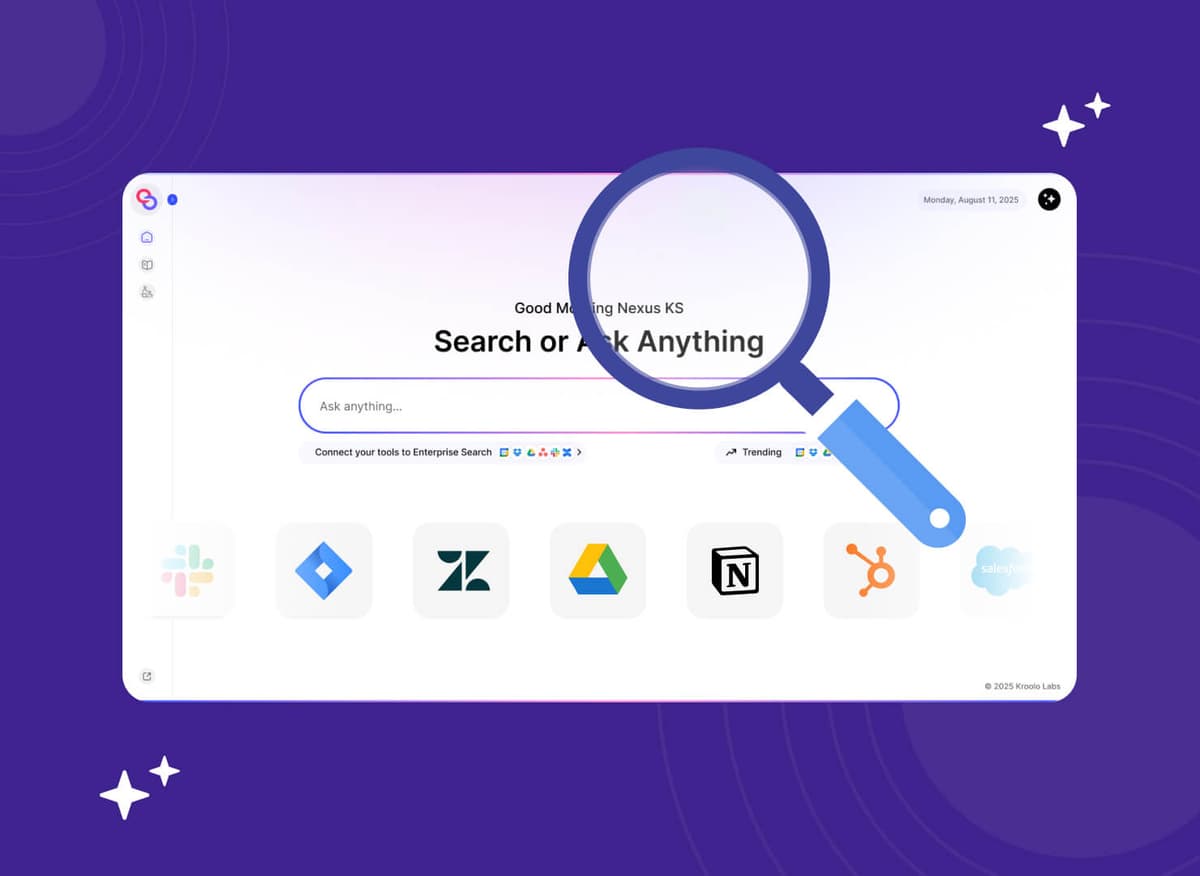
For teams seeking a unified approach to enterprise search, Kroolo offers an integrated solution designed to eliminate the frustration of scattered information. Instead of toggling between multiple tools, chats, and project files, teams can access everything they need from a single search interface.
The platform combines intelligent indexing and context-aware filtering to understand search intent. It delivers relevant results from tasks, conversations, documents, and knowledge base content. With built-in security protocols, it ensures sensitive data remains protected while providing appropriate access to authorized users.
By centralizing search across project management, communication, and documentation systems, the solution helps teams reduce missed updates, accelerate decision-making, and improve overall productivity.
Tags
Productivity